

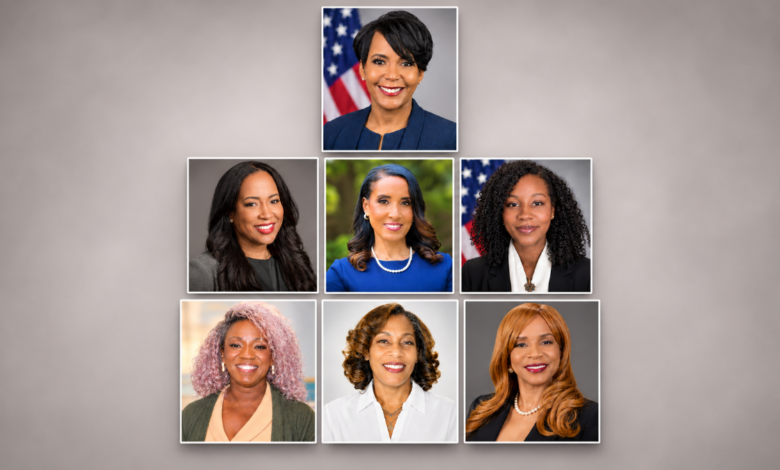
Nearly three decades after Arizona’s historic “Fabulous Five,” Georgia elects seven Black women to its eight major statewide executive offices, including Keisha Lance Bottoms, the nation’s first Black woman governor-elect.
By Miles J. Edwards | A.T.L. N.E.W.S. Georgia Bureau
ATLANTA, GA | November 5, 2026 – Twenty-eight years after Arizona made American political history by electing women to its five highest executive offices, Georgia has reached a milestone of its own. In the November 3 midterm elections, voters elected seven Black women to seven of the state’s eight major executive offices, establishing a new era of political representation in a state whose history has long been shaped by racial and gender barriers.
Among the seven is former Atlanta Mayor Keisha Lance Bottoms, whose election as governor marks a historic first not only for Georgia but for the entire United States. Bottoms became the first Black woman elected governor of an American state, joining six other Black women who secured victories in races for secretary of state, attorney general, agriculture commissioner, insurance commissioner, labor commissioner, and state school superintendent.
Their collective victories represent a striking transformation in Georgia’s government, particularly considering that most of these offices had previously been occupied by men. When A.T.L. N.E.W.S. examined the growing presence of women in statewide elections on October 11, the candidates represented the possibility of a major political shift. Less than a month later, voters turned that possibility into electoral reality.
From Arizona’s Fabulous Five to Georgia’s Magnificent Seven
Georgia’s achievement invites comparison with one of the most significant milestones in the history of women’s political representation in the United States. In November 1998, Arizona voters elected five women to the state’s five highest executive offices, creating the first all-female lineup of top statewide leadership in American history.
Known as Arizona’s “Fabulous Five,” the group consisted of Republican Governor Jane Dee Hull, Republican Secretary of State Betsey Bayless, Democrat Attorney General Janet Napolitano, Republican Treasurer Carol Springer, and Republican Superintendent of Public Instruction Lisa Graham Keegan. The five women began serving together in January 1999, demonstrating that women from different political backgrounds could simultaneously occupy the highest levels of state government.
Their election was widely recognized as an unprecedented development in American politics. Although women had previously served as governors and held other statewide offices, Arizona became the first state where women occupied all five positions at the top of its executive leadership structure.
Georgia’s 2026 election echoes that achievement while introducing a different historical dimension. Rather than simply increasing the number of women occupying executive offices, voters elected seven Black women to positions overseeing much of the state’s executive government. Their victories illustrate the growing political presence of a demographic that has historically faced significant barriers to holding statewide office, particularly in the American South.
The comparison also highlights an important distinction. Arizona’s five women represented different political parties and backgrounds, while Georgia’s seven incoming executive officeholders are all Democrats and Black women. Georgia’s eighth major executive office, lieutenant governor, will be occupied by Democrat Josh McLaurin.
Meet Georgia’s Magnificent Seven
Keisha Lance Bottoms | Governor-elect
Former Atlanta Mayor Keisha Lance Bottoms defeated Republican businessman Rick Jackson to become Georgia’s first woman governor, its first Black governor, and the first Black woman elected governor of a United States state. Her victory ended nearly 24 years of Republican control of Georgia’s Governor’s Mansion and marked the first successful Democratic gubernatorial campaign in the state since Roy Barnes won election in 1998.
Bottoms served as Atlanta’s mayor from 2018 until 2022 before taking on national responsibilities in President Joe Biden’s administration. Her gubernatorial campaign emphasized expanding healthcare access, strengthening public education, addressing affordability, and increasing economic opportunities for Georgia families. Her transition from municipal leadership to the governor’s office places her at the center of one of the most significant changes in Georgia politics in recent decades.
Penny Brown Reynolds | Secretary of State-elect
Former Fulton County judge Penny Brown Reynolds defeated Republican Tim Fleming to become Georgia’s first Black woman elected secretary of state. Reynolds will oversee an office responsible for coordinating elections, maintaining corporate registrations, and administering professional licensing functions. Her election comes as Georgia continues to attract national attention over election administration, voting access, and public confidence in the electoral process.
Tanya Miller | Attorney General-elect
Attorney and former state representative Tanya Miller defeated Republican Brian Strickland to become Georgia’s next attorney general. The position serves as the state’s principal legal office, overseeing litigation involving state government, defending state laws, and providing legal representation to Georgia agencies. Miller’s election gives Georgia its first woman elected attorney general and places another Black woman in one of the state’s most influential executive positions.
Katherine Juhan-Arnold | Agriculture Commissioner-elect
Katherine Juhan-Arnold defeated Republican incumbent Tyler Harper to become Georgia’s next agriculture commissioner. Her election brings new leadership to an agency responsible for agricultural regulation, food safety, and consumer protection in a state where farming and related industries remain major economic contributors. Juhan-Arnold founded a nonprofit connecting farmers with markets and families with locally grown food, an experience that informs her interest in agricultural access, rural economic development, and support for Georgia producers.
Keisha Sean Waites | Insurance Commissioner-elect
Former state representative and Atlanta City Council member Keisha Sean Waites defeated Republican incumbent John King to become Georgia’s next insurance and fire safety commissioner. The office is responsible for regulating the insurance industry, overseeing compliance with state insurance laws, and administering important fire safety responsibilities. Her victory comes amid public concerns about insurance premiums, coverage costs, and the financial pressures facing Georgia homeowners, drivers, and businesses.
Nikki Porcher | Labor Commissioner-elect
Nikki Porcher defeated Republican incumbent Bárbara Rivera Holmes to become Georgia’s next labor commissioner. A United States Air Force veteran, entrepreneur, and founder of Buy From A Black Woman, Porcher will oversee responsibilities involving unemployment insurance, labor market information, and employment services. Her victory followed an unusual contest in which both major-party nominees were women, ensuring that the office would continue to have female leadership regardless of which candidate prevailed.
Lydia Powell | State School Superintendent-elect
Educator Lydia Powell defeated Republican incumbent Richard Woods to become Georgia’s next state school superintendent. Powell will oversee the Georgia Department of Education, including statewide educational standards, administrative responsibilities, and support for the state’s public school systems. Her election places a Black woman in a statewide leadership position affecting students, teachers, administrators, and families throughout Georgia.
Black Women and Georgia’s Long Struggle for Political Representation
The election of Georgia’s Magnificent Seven carries particular historical significance because of the state’s role in the American civil rights movement and the generations of Black women who helped expand political participation. From voter-registration campaigns and community organizing to education, public advocacy, and legislative service, Black women have played influential roles in shaping Georgia’s political landscape despite facing longstanding obstacles to executive leadership.
Georgia’s history includes decades in which discriminatory voting laws, segregation, and unequal access to political institutions restricted opportunities for Black Americans. Even after the passage of landmark federal civil rights legislation, representation in the state’s highest elected offices changed gradually, with women and Black candidates continuing to encounter substantial political barriers.
The 2026 election builds upon earlier breakthroughs, including the election of Raphael Warnock as Georgia’s first Black United States senator and the historic gubernatorial campaigns of Stacey Abrams. In 2018, Abrams became the first Black woman nominated for governor by a major American political party, challenging Republican Brian Kemp in an election that drew national attention. She again sought the governorship in 2022, helping sustain conversations about voting access, political engagement, and the changing demographics of Georgia’s electorate.
Four years later, Bottoms accomplished what had never previously been achieved by a Black woman in an American gubernatorial election. Her victory, accompanied by the election of six other Black women to major executive offices, reflects the extent to which Georgia’s political leadership has changed.
Historic Victories and the Responsibilities of Leadership
Although their collective victories represent an important development in political representation, the Magnificent Seven will assume offices with separate constitutional and administrative responsibilities. Their authority will extend across healthcare, education, elections, consumer protection, agriculture, legal affairs, workforce services, and other areas affecting the daily lives of Georgia residents.
The incoming Democratic administration will also face the challenge of working with lawmakers and institutions whose political priorities may differ from those of the newly elected executive officials. The governor’s authority is distinct from that of the attorney general, secretary of state, and other constitutional officers, and many major policy changes will require cooperation with the Georgia General Assembly.
Their election does not automatically determine the direction of Georgia’s policies or eliminate longstanding disagreements over government spending, economic development, public services, and social issues. It does, however, establish a different composition of executive leadership and create new opportunities for the incoming officials to implement the priorities they presented to voters.
For Georgia, the broader significance of November 3 lies in the number of women elected, the offices they will occupy, and the historical barriers represented by their victories. While Arizona’s Fabulous Five demonstrated in 1998 that women could simultaneously lead a state’s highest executive offices, Georgia’s Magnificent Seven mark another chapter in the evolution of representation within American state government.
A New Chapter in Georgia History
When A.T.L. N.E.W.S. published A Changing Georgia: Women Compete in Eight of 10 Major Statewide Races on October 11, the story examined the changing political landscape and the growing influence of women seeking positions that had traditionally been held by men. The election results have now provided a clear outcome: all eight women featured in that report won their respective races, including Shelia Edwards, who was elected to the separate District 5 seat on Georgia’s Public Service Commission.
The seven executive officeholders will begin their terms in January 2027, becoming part of a historical record that connects their electoral victories to the broader advancement of women in American government. Their accomplishments also stand alongside those of the women who preceded them, including Arizona’s Fabulous Five, whose 1998 election helped establish a national precedent for women’s representation in executive leadership.
Nearly three decades after Arizona’s achievement, Georgia has added its own chapter to that history. Seven Black women have been elected to seven of the state’s eight major executive offices, and one of them has achieved a milestone no Black woman in the United States had previously reached.
Together, they are Georgia’s Magnificent Seven, seven women whose election has changed the face of the state’s executive leadership and established a new chapter in American political history.