

As Skydance absorbs Warner Bros. Discovery, one of Atlanta’s most recognizable corporate legacies moves another step away from the city and the name of the man who built it.
ATLANTA – Atlanta has watched plenty of familiar corporate names disappear over the years, but few were as closely tied to the city’s identity as Turner Broadcasting. Some hometown companies vanished through mergers, while others relocated their headquarters, reorganized or became pieces of much larger corporations. For longtime Atlantans, names once closely associated with the city — BellSouth, SunTrust, Coca-Cola Enterprises and others — have become reminders that even major hometown institutions are not permanent.
But the continued disappearance of Turner feels different. On Oct. 6, Skydance completed its acquisition of Warner Bros. Discovery, bringing Warner Bros., HBO, CNN, TBS, TNT and other properties into a massive entertainment company led by David Ellison. Warner Bros. Discovery now survives as a wholly owned subsidiary of Skydance, marking another major transformation for media properties that have changed corporate hands repeatedly over the past three decades.
For Atlanta, however, this transaction carries another meaning. It represents yet another chapter — and perhaps the most symbolic one yet — in the slow disappearance of the media empire once known as Turner Broadcasting System.
For me, that story is personal.
Before Atlanta Became Hollywood, Turner Broadcasting Made It Turner Town
Long before Georgia became one of America’s major film-production centers, Atlanta had already demonstrated that a global media company could be built in the South. Ted Turner proved it by taking a struggling Atlanta television station and gradually transforming it into the foundation of an international media empire.
Turner entered Atlanta television in 1970 after purchasing struggling UHF station Channel 17. He eventually put the station on satellite, helping pioneer the “superstation” model and introducing Atlanta Braves baseball to television audiences across the country. Turner Broadcasting System grew from those beginnings, followed by CNN in 1980, TNT in 1988, Cartoon Network in 1992 and Turner Classic Movies in 1994.
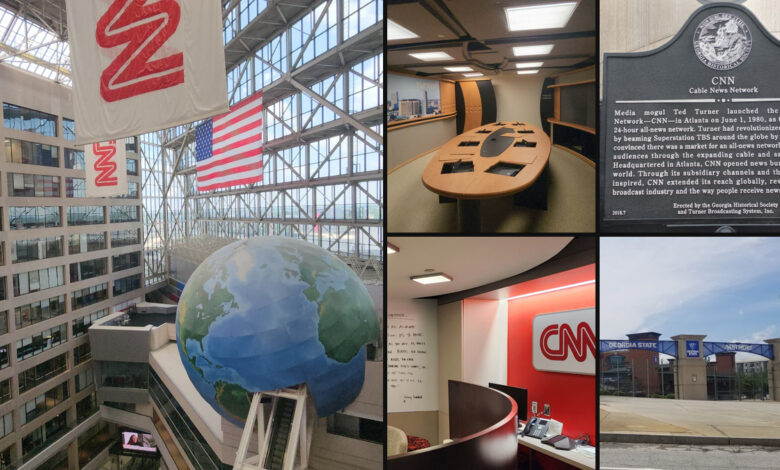
CNN may have been Turner’s most audacious gamble. Rather than building the world’s first 24-hour television news network in New York, Washington or Los Angeles, Turner launched it from Atlanta. CNN’s original headquarters operated from Techwood Drive, and an idea that many doubted could succeed eventually helped change television journalism around the world.
For a generation of Atlantans, Turner wasn’t simply another wealthy businessman whose company happened to be headquartered here. His television networks, sports teams and larger-than-life personality became intertwined with Atlanta’s identity, giving the city a place in the national media landscape long before Georgia’s modern film and television production boom.
I Arrived in a Different Atlanta
I moved to metro Atlanta as a teenager during the summer of 1996, just as the city was hosting the Centennial Olympic Games and introducing itself to much of the world. Downtown was crowded with international visitors, Centennial Olympic Park was new, construction seemed to be everywhere and Atlanta carried the energy of a city convinced that something bigger was happening.
Just south of downtown stood another symbol of that ambition: Centennial Olympic Stadium. After the Games, the massive stadium was converted into the new home of the Atlanta Braves, creating a question that generated considerable discussion around the city: What would Atlanta call it?
There was substantial support for naming the stadium after Braves legend Hank Aaron. Instead, officials announced in September 1996 that the ballpark would honor Ted Turner. Atlanta later renamed the adjoining portion of Capitol Avenue as Hank Aaron Drive, while the former Olympic stadium became Turner Field.
“The Ted,” as Atlantans would eventually call it, opened for the Braves in 1997. By then, I had no idea that the stadium would soon become an important part of my own Atlanta story.
My First Atlanta Job Was at “The Ted”
In the fall of 1997, I landed my first job in Atlanta, working for Aramark at Turner Field. I primarily worked in retail sales at the Clubhouse Store in the plaza, and the position eventually continued beyond baseball season as I also assisted with stadium tours during the offseason.
For roughly four years, Turner Field became part of my life and Atlanta gradually became part of my identity. I was born in Oakland, California, and spent part of my childhood across the bridge in San Francisco. Baseball had already been part of my life because I grew up loving the Oakland Athletics.
Working at Turner Field changed my baseball loyalties in a way I never expected. Spending years around the Braves, the stadium, the fans and the culture surrounding the team pulled me into Braves Country. More than two decades later, the Braves remain my favorite sports team of all time.
Some of my favorite memories of those years had little to do with the job itself. I remember seeing Ted Turner walking through the stadium wearing a suit with a Braves cap on his head. I remember Hank Aaron coming through during our annual 60% off sale and jokingly complaining about how expensive the merchandise still was. Those encounters seemed almost ordinary at the time because Turner Field had a way of putting you in the same building with people you had previously known only from television or baseball history.
There were plenty of other moments that made working at “The Ted” feel like much more than a first job. When home run sluggers such as Mark McGwire and Sammy Sosa came to Atlanta, I would sneak up to Coca-Cola Sky Field hoping that somehow a home run ball would find its way to me — and that I might walk away with the $1 million prize associated with catching one.
Then there were the nights when simply finding out who was pitching could change our entire outlook on the workday. I remember coming into Turner Field and asking who was starting that night’s game. Whenever the answer was Greg Maddux, those of us working at the stadium knew exactly what that meant: This was probably going to be a quick game, and we might be getting off work early.
Maddux was famous for working quickly and efficiently on the mound, but as stadium employees, we appreciated that efficiency for an entirely different reason. A short Maddux game meant an early night for us. It became one of those little inside experiences of working at a Major League Baseball stadium — while thousands of fans were coming to watch one of baseball’s greatest pitchers, some of us were also thinking, Maddux is pitching tonight? We might get out of here early.
I also remember running into Brian Jordan on the service level and asking him to point me toward the Braves clubhouse. He would go on to hit home runs in back-to-back games during that series, making the encounter even more memorable. Years later, I can still remember joking with Braves executive John Schuerholz about how upset I was that the team had traded John Rocker.
Yet some of the most meaningful memories weren’t encounters with famous people. I made friends from all over metro Atlanta while working at Turner Field, and those relationships became part of how a teenager who had arrived from out of town began finding his place in a new city.
Then there was my favorite baseball memory of them all: getting to watch Kenny Lofton play for the Braves. Residing with my maternal side in Western North Carolaina I watched Lofton play for the Asheville Tourist minor league team.
Lofton had been my all-time favorite baseball player, so seeing him wearing an Atlanta uniform during my first season working at Turner Field connected two parts of my life in a way I could never have anticipated. The kid who grew up watching baseball in the Bay Area was now working inside a Major League Baseball stadium in Atlanta, watching his favorite player take the field for the team that would eventually become his own favorite franchise.
Those experiences are part of why Turner Field means more to me than a stadium that no longer carries its old name. It was where I began building a life in Atlanta.
Turner Broadcasting represented something even bigger. It was one of those companies I dreamed of working for someday because, for a young person interested in writing, filmmaking and media, Turner made Atlanta feel like a city where those dreams did not necessarily require a one-way ticket to New York or Los Angeles.
A global television empire had already been built right here in Atlanta. CNN, TBS, TNT and Cartoon Network were here, while the Braves were being watched across America because Turner had figured out how to transform a local Atlanta television station into something much bigger.
Atlanta wasn’t simply following the media business. For a while, Atlanta was helping reinvent it.
The End Actually Began 30 Years Ago
That history is what makes today’s Skydance transaction feel less like the sudden death of Turner Broadcasting and more like the final pages of a corporate story that Atlanta has been watching unfold for three decades.
The turning point came in 1996, when Turner Broadcasting System merged with Time Warner. Ironically, that was the same year I arrived in Atlanta. Turner’s networks and brands survived the transaction, but the independent Atlanta company Ted Turner had built no longer completely controlled its own destiny.
The corporate transformations continued. AT&T acquired Time Warner in 2018 and renamed the media operation WarnerMedia. During the WarnerMedia era, the Turner name itself was gradually removed as a corporate organizational identity, even though individual brands with Turner roots — including TBS, TNT, CNN and Turner Classic Movies — remained.
Then, in April 2022, AT&T spun off WarnerMedia and combined it with Discovery, creating Warner Bros. Discovery. Four years later came yet another transformation, with Skydance completing its acquisition of Warner Bros. Discovery on Oct. 6, 2026.
The resulting entertainment giant encompasses Warner Bros., Paramount Pictures, CBS, CNN, HBO and a vast collection of cable, streaming, film, television and sports properties. Many of the assets Ted Turner created have not disappeared, but the corporate identity that once connected them so visibly to Atlanta has faded with every merger and restructuring.
First Turner Field. Then CNN Center.
You can almost trace the fading Turner era through Atlanta’s physical landscape.
Turner Field closed as the Braves’ home after the 2016 season when the team relocated to Cobb County. The former Olympic stadium was transformed for Georgia State University, leaving “Turner Field” to become another name from Atlanta’s past.
Then came CNN Center. For decades, those enormous red CNN letters overlooking Centennial Olympic Park told visitors something important about Atlanta: A global news organization lived here. The building was more than an office complex or tourist attraction; it was one of downtown Atlanta’s most recognizable symbols and a physical reminder of the city’s place in international media.
CNN ultimately moved its Atlanta operations out of the building. The former CNN Center was sold and redeveloped as The Center, or The CTR, with new retail, office, entertainment and public spaces replacing much of the building’s former identity.
I previously wrote about that transformation because CNN Center was personal to me, too. As a teenager and later as a father, writer and downtown worker, I spent countless hours moving between Centennial Olympic Park and CNN Center. Those places were part of how I came to know Atlanta.
That is why the changes are difficult to view simply as corporate transactions or real estate redevelopment. The CNN letters are gone, Turner Field is gone, Turner Broadcasting System no longer exists as the independent Atlanta company it once was, and Warner Bros. Discovery has now become part of Skydance.
Taken individually, each change can be explained as business. Taken together, they look like the gradual closing of an era.
But Turner Isn’t Really Gone
That may be the greatest irony in all of this: Corporate names can disappear much faster than their influence.
Turner’s name may no longer sit atop a major media corporation, but many of the ideas that emerged from his Atlanta empire remain deeply embedded in modern media. Twenty-four-hour television news became an industry standard, national cable networks became commonplace, sports became a cornerstone of cable programming, and libraries of classic movies became valuable television assets.
Perhaps most importantly, an Atlanta television station once dismissed as an insignificant UHF operation helped demonstrate that satellite distribution could transform a local broadcaster into a national network. Turner looked at the limitations of local television and saw an opportunity to build something much larger.
He also helped change how America viewed Atlanta. Turner’s companies demonstrated that an internationally influential media organization could be headquartered in Georgia and compete with companies operating from America’s traditional media capitals. In hindsight, that contribution to Atlanta may be just as significant as any individual network he created.
Today’s Georgia film industry regularly brings Hollywood productions to the state, but Turner demonstrated decades earlier that Atlanta did not have to merely serve as a location for someone else’s media industry.
Atlanta could build its own.
A Hometown Hero and a Hometown Dream
Ted Turner’s death earlier this year at 87 makes the timing of this latest corporate transformation especially poignant for those who remember the Atlanta he helped shape.
For me, Turner was a hometown hero, and Turner Broadcasting was the hometown corporation I once dreamed of working for. Perhaps that is why this merger feels different from watching another corporate logo change or reading another announcement about an acquisition.
When I think about Turner, I don’t immediately think about balance sheets, mergers or media properties. I think about being a teenager arriving in Atlanta during the Olympics, the excitement surrounding the Braves’ new stadium and going to work at Turner Field. I think about Ted Turner walking through the stadium in his suit and Braves cap, Hank Aaron joking with us during a merchandise sale and wondering whether a McGwire or Sosa home run might somehow make me a millionaire.
I think about hearing that Greg Maddux was pitching and realizing we might be going home early. I think about Brian Jordan, John Schuerholz, Kenny Lofton and the friends I made while working there. I think about CNN Center overlooking Centennial Olympic Park and how much larger the world of media seemed from Atlanta during those years.
Most of all, I remember believing Atlanta was a city where somebody with a crazy enough idea could build something capable of changing the world.
Ted Turner had already proven it.
The company he created has been merged, reorganized, renamed and absorbed repeatedly during the three decades since Turner Broadcasting joined Time Warner. Skydance is simply the newest corporate owner of pieces of that extraordinary legacy, and there may be more changes still to come.
Perhaps, then, the real story isn’t that Turner Broadcasting disappeared this week. Its disappearance happened gradually, through mergers, reorganizations, renamed companies, relocated teams, redeveloped buildings and fading corporate identities. Atlanta has been watching that process unfold for 30 years.
Yet the legacy remains every time someone watches CNN, TNT or TBS; every time an old MGM film appears on Turner Classic Movies; and every time a media entrepreneur decides that a revolutionary idea doesn’t have to come from New York or Hollywood.
The corporation may be gone, and the Turner name may increasingly belong to Atlanta history, but the city still carries the imprint of what Ted Turner created here.
Atlanta will always be the city where he built it.