

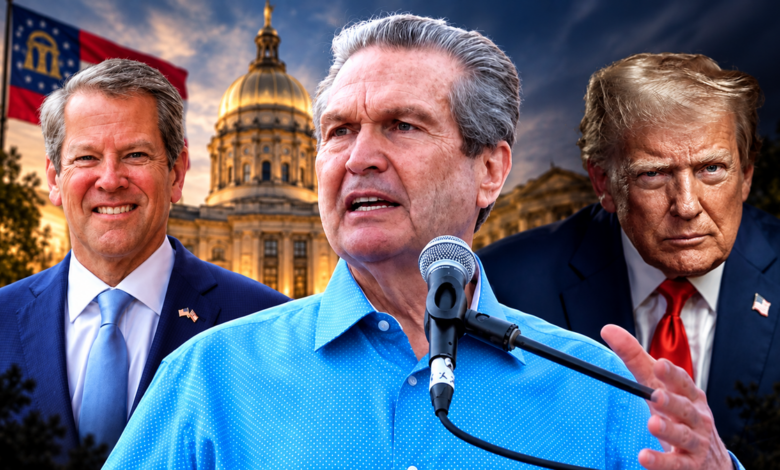
Republican Rick Jackson once promised to be Donald Trump’s “favorite governor.” At Tuesday’s Georgia gubernatorial town hall, however, Jackson repeatedly pointed to Brian Kemp as his model as Republicans nationwide confront the political weight of Trump’s declining approval ratings.
By Miles J. Edwards | A.T.L. N.E.W.S.
ATLANTA — Republican gubernatorial nominee Rick Jackson entered Georgia’s general election carrying a political promise that left little ambiguity about where he stood within the Republican Party: He wanted to become President Donald Trump’s “favorite governor.”
At Tuesday night’s gubernatorial town hall, however, Trump’s name was notably absent from Jackson’s own answers. Instead, as Jackson faced Democratic nominee and former Atlanta Mayor Keisha Lance Bottoms in their first and likely only debate before Election Day, the Republican candidate repeatedly positioned himself closer to another model of Georgia Republican politics: Gov. Brian Kemp.
The change was difficult to miss. When Bottoms attempted to tie Jackson to Trump and his administration’s policies, Jackson responded by emphasizing his willingness to disagree with Washington and invoking Kemp’s record of doing the same.
“I will stand up to anybody, just like Brian Kemp has done,” Jackson said when challenged over federal spending cuts affecting Georgia workers.
The exchange captured a larger strategic question hanging over Georgia’s gubernatorial election. Jackson won the Republican nomination after embracing Trump during the primary. Now, with the general election approaching and Trump’s national approval ratings falling, Jackson appears increasingly interested in presenting himself to Georgia voters as a Kemp-style Republican — conservative, but willing to establish political distance from the president when Georgia’s interests diverge from Washington.
Bottoms tries to put Trump back into the race
Bottoms repeatedly attempted to prevent Jackson from making that transition without answering for his earlier positions. “My opponent has said he wants to be Trump’s favorite governor,” Bottoms said during the debate, also reminding voters that Jackson previously described his political approach as Trump “with a Southern tone.”
Jackson did not respond by renewing that pledge. Instead, he talked about Kemp.
That distinction may become one of the defining dynamics of the final weeks of Georgia’s gubernatorial campaign. Jackson’s relationship with Trump was hardly incidental during the Republican primary. According to reporting by The Atlanta Journal-Constitution, Jackson contributed $2 million to Trump’s campaign and met with the president multiple times at Trump properties to discuss politics. Yet Trump never formally endorsed Jackson during the Republican primary.
On Tuesday night, Jackson appeared less interested in emphasizing that relationship and more interested in establishing his own political identity for the general election.
The Kemp strategy
Jackson’s shift toward Kemp did not begin at the town hall. Since winning the Republican nomination, he has increasingly emphasized affordability, ethics, healthcare and other issues aimed at independent and split-ticket voters while campaigning alongside Kemp and other establishment Georgia Republicans.
The strategy reflects the unusual political history between Kemp and Trump. Kemp resisted Trump’s attempts to overturn Georgia’s 2020 presidential election results, drawing repeated attacks from the president. Trump later backed former U.S. Sen. David Perdue against Kemp in the 2022 Republican gubernatorial primary.
Kemp defeated Perdue by more than 50 percentage points. He then defeated Democrat Stacey Abrams by nearly 300,000 votes in the general election, winning reelection by approximately 7.5 percentage points.
That performance demonstrated something particularly important to Georgia Republicans: A Republican could survive a confrontation with Trump, retain conservative voters and still appeal to independents and moderate voters. Jackson now appears to be testing whether a similar formula can work for him.
Jackson says Georgia comes before Washington
During Tuesday’s town hall, Jackson presented himself as someone willing to work with the federal government without automatically following it. When asked about Georgia’s relationship with Washington, Jackson argued that the state needs a productive relationship with whoever occupies the White House because federal funding and federal decisions directly affect Georgia.
At the same time, he emphasized that a governor must be prepared to challenge Washington when necessary. That language closely resembles the political identity Kemp developed during his second term.
Bottoms, meanwhile, argued Georgia should be more willing to challenge the Trump administration in court when federal actions threaten the state. The candidates’ disagreement therefore extended beyond their individual relationships with Trump. It raised a broader question about what Georgia’s relationship with Washington should look like during another Trump presidency.
Trump is becoming a problem for Republicans beyond Georgia
Jackson’s changing emphasis comes as Republicans across the country confront a difficult political environment ahead of the November 3 midterm elections. A Reuters review of 62 competitive congressional races found Republican candidates in 41 of them — roughly two-thirds — have either publicly broken with Trump on at least one policy or deemphasized their relationship with him.
Some candidates have removed Trump’s name, image or endorsements from campaign websites. Others have skipped Trump events or declined to say whether they want the president campaigning with them. The movement does not amount to a wholesale Republican rejection of Trump. Many candidates continue supporting much of his agenda while selectively distancing themselves from unpopular policies or from the president personally.
The trend is widespread enough, however, to suggest a deliberate general-election strategy. A Reuters/Ipsos poll released this week put Trump’s approval rating among registered voters at 32%, a career low. Registered voters favored Democratic congressional candidates over Republicans 44% to 37%, while Democrats held an even larger advantage among independents.
For Republican candidates running competitive races, the political calculation is becoming increasingly complicated. They need Trump’s supporters to vote, but they also need independents and moderate voters who increasingly disapprove of his presidency. Jackson appears to be navigating precisely that problem in Georgia.
From Trump’s coalition to Kemp’s coalition
Georgia Republicans currently appear to be testing two different theories about how to win in November. Republican U.S. Senate nominee Mike Collins has continued leaning heavily into his MAGA identity and relationship with Trump as he challenges Democratic Sen. Jon Ossoff. Jackson is taking a noticeably different route.
Rather than centering Trump, Jackson is increasingly attempting to recreate the coalition that helped Kemp win comfortably in 2022: Republican base voters combined with independents and some voters willing to split their tickets. That distinction could make Georgia one of the country’s most interesting tests of Republican politics in the Trump era.
Two major statewide Republican candidates will appear before essentially the same electorate in November. One is emphasizing Trump. The other increasingly looks toward Kemp.
Policy dominated much of the town hall
The political maneuvering surrounding Trump was only one part of Tuesday’s hourlong town hall at Assembly Studios. Undecided Georgia voters questioned Bottoms and Jackson about healthcare, affordability, education, data centers, election security, mental health and the growing use of automated license-plate-reading cameras.
Both candidates expressed support for expanding healthcare coverage, although they offered different approaches. Bottoms supports full Medicaid expansion and pledged to increase starting teacher salaries to $60,000, provide free technical college and pursue tax relief for Georgia families. Jackson emphasized higher-paying jobs, vocational and technical education, healthcare price transparency and significant reductions in Georgia’s income tax.
Data centers produced another sharp disagreement. Bottoms supports a temporary statewide pause on new data-center development while Georgia develops stronger regulations surrounding water and energy use. Jackson opposes a statewide moratorium but says communities should approve projects and receive economic and utility benefits from developments built in their areas.
Those differences give Georgia voters substantive policy choices. But the Trump question may reveal something equally important about how Jackson believes the election can be won.
The general election changes the calculation
Republican primaries and Georgia general elections reward different political coalitions. During the primary, demonstrating loyalty to Trump helped candidates compete for Republican voters. November requires something broader.
Georgia has spent much of the past decade moving between the two parties. Joe Biden narrowly carried the state in 2020. Kemp won comfortably in 2022. Trump returned Georgia to the Republican presidential column in 2024. That recent history means neither party can assume statewide victory.
Jackson therefore needs Republican voters who remain strongly supportive of Trump while also competing for independents and suburban voters who may view the president much less favorably. Bottoms has every incentive to make that balancing act difficult.
Expect her campaign to repeatedly remind voters about Jackson’s previous promise to become Trump’s “favorite governor,” his financial support for Trump and his earlier political rhetoric. Jackson, meanwhile, appears increasingly likely to respond by pointing toward Kemp and emphasizing an independent Georgia-centered governing approach.
A revealing November test
Whether that strategy works will tell Georgia — and perhaps the national Republican Party — something important. Trump remains the dominant figure within the GOP, but the midterm elections will test whether Republican candidates in competitive states benefit from running toward him or creating enough distance to establish their own political identities.
Jackson once made becoming Trump’s “favorite governor” part of his political pitch. With Election Day less than a month away, his message sounds different.
Tuesday night, Jackson seemed less interested in becoming Georgia’s version of Donald Trump and more interested in convincing voters that his model for governing the state is the Republican already occupying the governor’s mansion: Brian Kemp.