


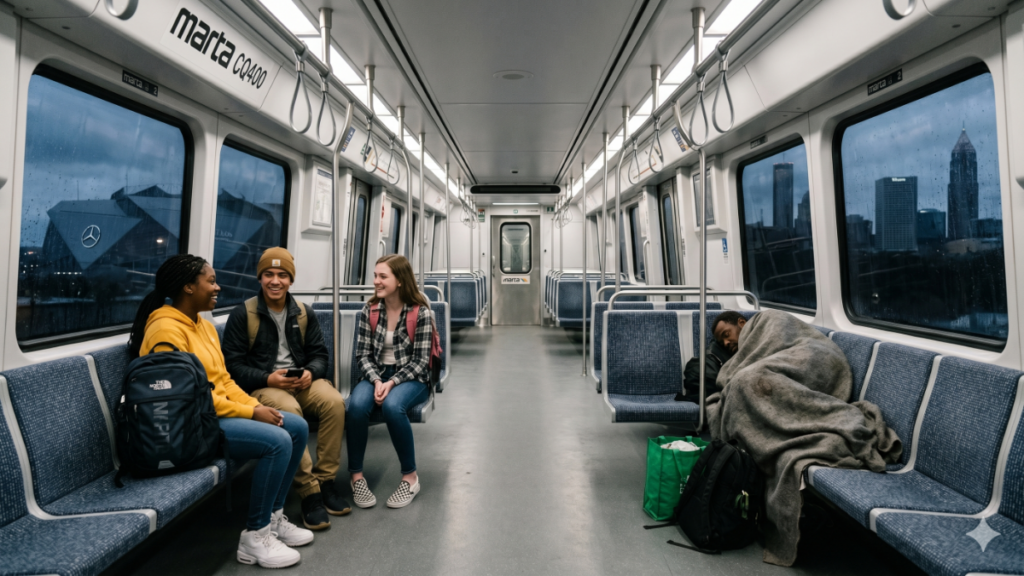
With the FIFA World Cup weeks away, aggressive street cleanups are clearing downtown sidewalks. But the optics-driven rush is just shifting the crisis onto transit lines.
ATLANTA — For the price of a $2.50 Breeze fare, a MARTA rail car offers a rare refuge. It provides climate control, temporary safety, and a few hours of peace.
Recently, however, local commuters have expressed growing frustration. Many complain about unhoused individuals sleeping across seats or lingering at the Five Points station. As a result, a misplaced narrative has taken hold across the metro area.
Public anger heavily targets the transit system itself. Critics frequently demand tighter turnstiles, heavier policing, and aggressive crackdowns. Therefore, this blame completely ignores a stark municipal reality.
MARTA is not the source of Atlanta’s homelessness crisis. Instead, it is a mirror reflecting it. The train has become the city’s default shelter because local infrastructure leaves vulnerable residents with nowhere else to go.
There is a profound, almost tragic irony in the public outrage over people buying time on the tracks. If you grew up in Atlanta, you likely remember using the transit system to escape. Many kids skipped school and paid a single fare to sit on the train seats. They watched the tunnel walls blur past, riding from one end of the line to the other just to kill an afternoon.
For a teenager, it was a harmless sanctuary to evade the truancy officer. Conversely, for an unhoused adult in Atlanta today, that exact same rhythm is not a game. It is a weary calculation for survival. The mechanics are identical, but the stakes are life and death.
This desperate reliance on transit lines has escalated dramatically. The clock is ticking down to the 2026 FIFA World Cup. Under the city’s ambitious “Downtown Rising” initiative, municipal leaders set a high-stakes goal. They want to eliminate unsheltered homelessness in the downtown core before international soccer fans arrive at Mercedes-Benz Stadium.
The city relies on a “housing first” model through the nonprofit agency Partners for HOME. Officials boast that the program has successfully transitioned more than 460 individuals into stable housing. Even so, local advocates argue the numbers do not tell the whole story.
An estimated 1,000 people still sleep completely unsheltered across the city on any given night. Because of this, the frantic rush to clear downtown zones has triggered an aggressive wave of camp cleanups. Critics warn that these sweeps are simply an exercise in cosmetic displacement.
To understand why a transit car remains a critical sanctuary, one must look at the reality of these street sweeps. In January 2025, municipal policy escalated into undeniable tragedy on Old Wheat Street.
City public works crews and police moved in to clear a long-standing homeless encampment in the historic Sweet Auburn community. The sweep took place directly across the street from Ebenezer Baptist Church.
Community advocates fiercely argued the cleanup was rushed to improve the area’s optics ahead of the annual Martin Luther King Jr. Day parade. During the chaos, a five-ton Department of Public Works front loader crushed a tent. Inside was Cornelius Taylor, an unhoused man who was killed instantly beneath the heavy machinery.
Taylor’s horrific death forced a temporary reckoning and sparked intense public outcry. The city quickly formed a Homelessness Task Force. Officials also mandated tighter safety protocols, including using thermal imaging technology to check tents before clearing them.
Nevertheless, the policy of displacement intensified as the World Cup approached. This pre-tournament enforcement was laid bare again at the massive Bell Street encampment.
The camp sat directly underneath the I-85 overpass near Grady Memorial Hospital. For years, the stretch of sidewalk along Coca-Cola Place had been a dense community of tents and mattresses.
During a weekend-long operation, city crews cleared tons of debris. Immediately after, workers installed structural barriers and increased patrols to prevent tents from reforming.
Activists point out that bulldozing a camp on Bell Street does not erase the human need for shelter. The individuals displaced do not magically disappear. Instead, they are simply scattered from one block to the next, chased away by private ambassadors and police.
Consequently, a deep local anxiety has taken root regarding the transit lines. Many residents and business owners fear that the visible reality of poverty will give international visitors a negative impression of Atlanta.
This anxiety has intensified with the upcoming deployment of MARTA’s brand-new CQ400 rail cars. The highly anticipated, state-of-the-art fleet is designed to modernize the city’s transit image.
However, the rollout has sparked a polarizing debate among riders. Many patrons openly worry that unhoused residents currently using the trains as a shelter will make the new cars dirty very quickly. They fear the pristine interiors, modern seating, and fresh carpets will be immediately degraded.
This friction creates an environment of intense polarization on the platforms. The pressure to protect the city’s global brand directly collides with the basic survival strategies of its poorest residents.
When street options shrink, the city’s lack of low-barrier emergency beds forces people back onto the tracks. For someone pushed out of a tent into torrential rain or oppressive heat, buying time on a train is a rational act of survival.
Transit officials have tried to address this municipal deficit through initiatives like MARTA HOPE. This program pairs outreach workers with transit police to offer help.
But a transit agency cannot build affordable housing. Furthermore, it cannot create the thousands of emergency beds Atlanta desperately lacks.
Until city policy shifts its focus from cosmetic downtown preservation to genuine, long-term low-barrier infrastructure, the sweeps will continue to fail. Pushing people off the streets to save face for a global audience will only keep pushing them onto the tracks. Ultimately, MARTA will remain the moving sanctuary for a city that refuses to house its own.
For a deeper look into the intense community response and the immediate policy changes that followed the tragic loss of Cornelius Taylor on Auburn Avenue, watch this Local News Coverage on the Encampment Sweep Controversy. This broadcast provides vital local context on the City Council pushback and the standard operating procedures that directly shaped subsequent sweeps like the one on Bell Street.