

How student-athletes and organizers are leveraging the South’s cultural engine to save the vote.
ATLANTA, GA — The movement that began as a digital murmur in early April has officially crystallized into a multi-state athletic and economic strike. In the thirteen days following the Supreme Court’s Louisiana v. Callais decision, a sophisticated coalition of student-athlete unions, legal advocates, and civil rights organizations has transformed the SEC from an athletic powerhouse into a high-stakes political battleground.
The strategy is a surgical strike against the “Midnight Sessions”—the rapid, post-ruling legislative meetings in Tennessee and Louisiana that effectively dismantled Black voting power through aggressive redistricting.
The Power of the 56 Percent
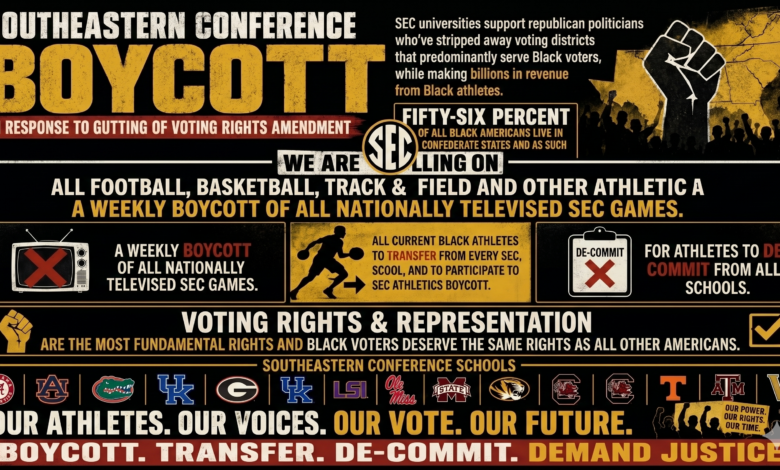
The movement’s operational foundation rests on a singular demographic leverage point: 56% of Black Americans live in the Southern states that comprise the SEC’s footprint. Organizers have turned this statistic into a call for “labor accountability,” arguing that a multi-billion dollar football industry cannot continue to harvest talent from communities while the states housing those universities strip those same communities of their representation.
Tactical Mobilization: The De-commitment Surge
The most potent tool in the organizers’ arsenal has been the De-commitment Surge. Since the April 29th ruling, a wave of elite four- and five-star recruits has announced a coordinated pivot away from the conference. The movement is now officially targeting all 16 member institutions, calling for athletes to refuse to play for:
- University of Alabama & Auburn University
- University of Arkansas
- University of Florida
- University of Georgia
- University of Kentucky
- Louisiana State University (LSU)
- University of Mississippi (Ole Miss) & Mississippi State University
- University of Missouri
- University of Oklahoma
- University of South Carolina
- University of Tennessee
- University of Texas at Austin & Texas A&M University
- Vanderbilt University
The Organizing Playbook
- The Recruiting Freeze: Organizers are facilitating meetings between recruits and legal experts to discuss the long-term impact of playing in states where their families face disenfranchisement.
- The Solidarity Portal: A “Transfer Pipeline” has been established, providing institutional and NIL (Name, Image, Likeness) support for players looking to move their talents to states that have proactively protected voting access or to HBCUs.
- Economic Blackout: Activists are training fans in “digital non-cooperation,” urging a mass cancellation of SEC-affiliated streaming services and a boycott of official university merchandise.
In cities across the South, community hubs are replacing traditional “Gameday” celebrations with “Voter Readiness” workshops. The goal is to drive record-low television ratings for the upcoming season, forcing the conference leadership to choose between their lucrative broadcast contracts and their silence on the suppression of their athletes’ families.