


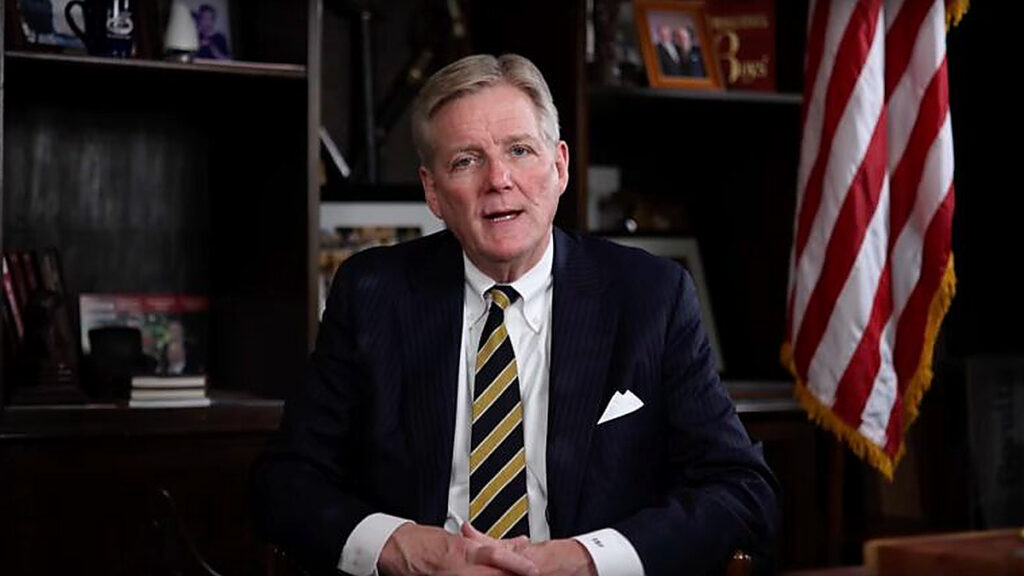
Newnan businessman who cultivated trust among Christian conservatives and political circles ordered to repay more than $76 million after hundreds of investors suffered devastating financial losses.
By A.T.L. N.E.W.S. Staff | October 26, 2026
NEWNAN, Ga. — A Georgia businessman whose financial empire was built on promises of lucrative investments, religious values and conservative political connections is headed to federal prison after admitting to orchestrating a massive fraud scheme that devastated hundreds of investors.
Edwin Brant Frost IV, founder of Newnan-based First Liberty Building & Loan, was sentenced Monday, October 26, to 15 years in federal prison for his involvement in a Ponzi scheme that federal regulators say raised at least $140 million from approximately 300 investors. U.S. District Judge Leigh Martin May also ordered Frost to pay more than $76 million in restitution, delivering a significant legal blow to a businessman whose reputation and political relationships helped establish his credibility with investors.
Frost pleaded guilty to one count of federal wire fraud in May 2026, acknowledging that First Liberty used money from new investors to pay earlier investors while concealing the company’s worsening financial condition. The guilty plea and subsequent sentencing concluded a major chapter of a criminal case that has raised troubling questions about financial oversight, political influence and the exploitation of personal trust.
A Financial Promise That Became a Multimillion-Dollar Nightmare
For years, First Liberty Building & Loan marketed itself as an alternative financing company capable of providing short-term commercial loans while generating substantial returns for investors. The Newnan operation attracted individuals who believed their money would finance legitimate business transactions, offering annual investment returns that could reach 18 percent.
According to the U.S. Securities and Exchange Commission (SEC), Frost and First Liberty raised at least $140 million between 2014 and June 2025 through promissory notes and loan participation agreements. Investors were told their funds would support short-term bridge loans to businesses awaiting permanent financing, including loans backed by the Small Business Administration or other commercial lenders.
However, federal regulators discovered that the company’s underlying investments were not performing as represented. Many loans had defaulted, leaving First Liberty unable to generate the revenue needed to satisfy its financial obligations. Rather than disclose the growing problems, investigators say Frost continued attracting new investors and used their money to make payments to existing clients.
By at least 2021, the operation had developed into a Ponzi scheme, according to the SEC. The arrangement created the appearance of a functioning investment business while concealing a deepening financial crisis that eventually left hundreds of individuals facing substantial losses.
Political Connections and Religious Trust Under Scrutiny
The First Liberty scandal has drawn particular attention because of Frost’s longstanding relationships within Georgia’s Republican political community and his company’s efforts to attract faith-based and conservative investors.
First Liberty cultivated an image of a business aligned with Christian principles and conservative economic values, promoting investment opportunities through media outlets and relationships that appealed to those audiences. Prosecutors argued that Frost leveraged this reputation to establish trust with individuals who believed they were placing their money in the hands of a responsible and ethically grounded businessman.
The financial controversy extended beyond the company’s investment practices. According to reporting by The Atlanta Journal-Constitution, Frost, his family members and affiliated businesses contributed approximately $1.4 million to political causes. Federal regulators alleged that at least $570,000 in investor funds was used to finance political contributions.
Those financial connections have created questions about whether individuals who believed they were financing small-business loans were unknowingly supporting political activities. The allegations concerning political donations do not, by themselves, establish wrongdoing by candidates or organizations that received contributions.
Millions Spent While Investors Faced Financial Ruin
Federal investigators also documented extensive personal spending that they allege was financed through money entrusted to First Liberty by investors.
According to the SEC, the disputed expenditures included more than $2.4 million in credit card payments, over $335,000 paid to a rare coin dealer and approximately $230,000 spent on family vacations. Investigators alleged that these transactions took place while the company continued to solicit investments despite growing financial difficulties.
The collapse of First Liberty in June 2025 brought the operation to an abrupt end. Shortly afterward, federal securities regulators filed a civil enforcement action against Frost and the company, seeking emergency relief and an asset freeze. The subsequent criminal proceedings eventually resulted in Frost’s guilty plea and Monday’s prison sentence.
Victims Describe Lost Savings and Shattered Retirement Plans
Behind the millions of dollars involved in the First Liberty scandal are hundreds of investors whose personal financial circumstances were dramatically altered by the company’s collapse.
During Monday’s sentencing proceedings, victims described the emotional and financial consequences of losing money they had expected to provide security during retirement. Some had invested substantial portions of their savings, while others depended on regular interest payments to support their daily expenses.
According to court documents described by local news organizations, one investor who had expected to retire in March 2026 instead found it necessary to remain employed. Another, already in their late 70s, reported returning to work after losing income previously provided by First Liberty investments.
The accounts illustrate how the collapse extended beyond financial statements and legal filings, affecting households that may have limited opportunities to recover their losses. Although Frost has been ordered to repay more than $76 million, a restitution judgment does not guarantee that victims will receive the full amount owed.
Prosecutors Demand Accountability as Supporters Seek Mercy
Before sentencing, federal prosecutors requested a 14-year prison term, arguing that the duration, scale and personal consequences of Frost’s conduct warranted substantial punishment. Defense attorneys sought a five-year sentence, pointing to his guilty plea, expressions of remorse and potential ability to work toward compensating victims.
The court also received numerous letters from family members, friends, religious leaders and community supporters who described Frost as a generous businessman and mentor. Some urged the judge to consider his years of charitable activities and community involvement when determining an appropriate sentence.
Those appeals presented a stark contrast with the testimony of investors who described depleted savings and unexpected financial hardship. Ultimately, Judge May imposed a 15-year sentence, exceeding the recommendation made by prosecutors while remaining below the 20-year statutory maximum for the wire fraud charge.
A Warning Beyond Georgia
The First Liberty case underscores the risks investors face when financial opportunities promise unusually high returns and rely heavily on personal relationships, community affiliations or religious credibility.
The company’s collapse also demonstrates why investors must distinguish between a financial institution’s marketing claims and the actual protections afforded to their investments. Despite its name, First Liberty Building & Loan was not a federally insured bank, and the investment notes it offered did not carry the protections associated with federally insured deposits.
For the hundreds of individuals affected by the scheme, Monday’s sentencing marks an important moment of criminal accountability. However, questions remain about how much of their lost money can ultimately be recovered and whether the broader regulatory proceedings will produce additional consequences.
For Frost, the sentence represents a dramatic reversal of fortune, transforming a prominent Georgia businessman into a federal prisoner. For his former investors, the financial and emotional consequences of First Liberty’s collapse may continue long after the criminal case has concluded.