


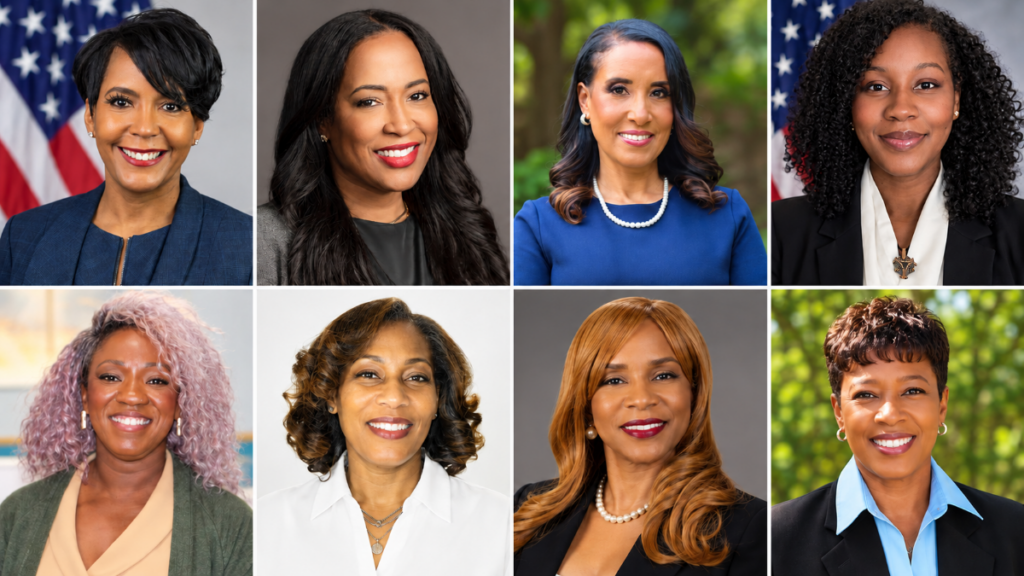
Women are running in eight of Georgia’s 10 major statewide races in 2026, and many of them are Black women seeking offices that have long reflected the state’s old political order. Their presence on the ballot does not settle every ideological question about Georgia, but it does show a state whose political leadership pipeline is changing.
By A.T.L. N.E.W.S. Staff | October 11, 2026
GEORGIA NEWS | POLITICS & GOVERNMENT
ATLANTA, Ga. — Georgia’s 2026 statewide ballot is offering voters more than a list of candidates. It is also offering a snapshot of how much the state’s political image has changed. In eight of the 10 major statewide races on the ballot this year, at least one woman is running, according to WABE’s 2026 Georgia general election candidate guide. Those races are governor, attorney general, secretary of state, agriculture commissioner, insurance and fire safety commissioner, labor commissioner, state school superintendent and Public Service Commission District 5.
That is a striking development in a state that for decades was politically defined by white male leadership, conservative dominance and slow-moving change in statewide representation. Now, a large share of the women on the ballot are Black women, and several are competing for offices that would mark major milestones if they win. Their campaigns speak to a broader transformation in Georgia, where demographic change, stronger Black political participation and a more competitive statewide environment have expanded who can credibly run for high office.
Among the most prominent candidates is Keisha Lance Bottoms, the Democratic nominee for governor, who is seeking to succeed term-limited Gov. Brian Kemp. In the race for attorney general, Tanya Miller is the Democratic nominee. Penny Brown Reynolds is running for secretary of state, while Katherine Juhan-Arnold is the Democratic candidate for agriculture commissioner. In the contest for insurance and fire safety commissioner, Keisha Waites is the Democratic nominee. Nikki Porcher is running for labor commissioner, Lydia Powell is seeking the office of state school superintendent, and Shelia Edwards is the Democratic nominee for Public Service Commission District 5.
The labor commissioner race adds another layer to the story because it features women from both major parties. Democrat Nikki Porcher is challenging Republican incumbent Bárbara Rivera Holmes, meaning that contest guarantees a woman will hold the office after the election regardless of the outcome. That detail reinforces the larger point: women are not just present at the edges of Georgia politics, but are now serious contenders in many of the most visible and influential statewide positions.
Still, the rise in female candidacies should be understood carefully. It is fair to say Georgia has become more inclusive and more representative in who is seeking power. It is also fair to say the state has become more competitive politically. But whether Georgia has become fully “progressive” is a more complicated question. Republicans remain a powerful force statewide, and two of the 10 major statewide races, lieutenant governor and Public Service Commissioner District 3, do not feature a woman among the major-party nominees.What the 2026 ballot proves most clearly is not that Georgia has abandoned its political traditions altogether, but that those traditions no longer fully control who gets to compete for statewide leadership.
That alone is significant. Georgia’s political history is deeply tied to the civil rights struggle, voting rights fights and long battles over access to power. For many years, Black women helped shape the state politically from the grassroots, even when they were underrepresented in the highest offices. The 2026 ballot reflects a different era, one in which Black women are not merely organizers or coalition-builders behind the scenes, but visible contenders for the state’s top executive and regulatory posts.
So while the election results will determine how much of this moment becomes lasting political power, the ballot itself already says something important. Georgia may still be ideologically divided, but it is undeniably evolving. The people running to lead the state look more like modern Georgia than the political establishment of the past. In that sense, the 2026 election is not just a contest for office. It is also a measure of how much Georgia has changed.