


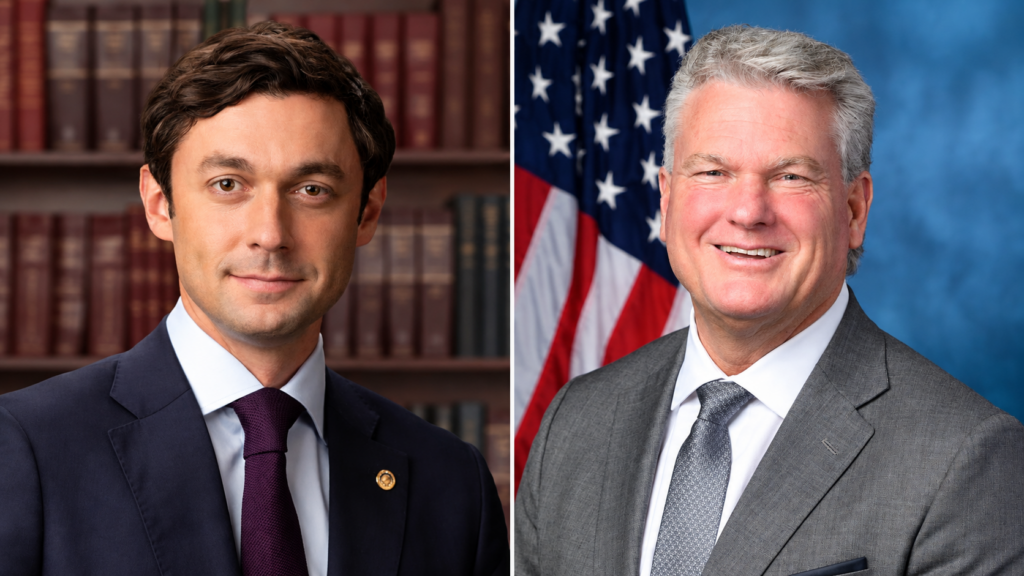
With control of the U.S. Senate potentially hanging in the balance, Jon Ossoff and Mike Collins prepare for a showdown that could expose deep political and personal divisions.
By A.T.L. N.E.W.S. Staff | October 8, 2026
ATLANTA, GA – Georgia’s nationally watched U.S. Senate race could reach a boiling point Thursday night as Democratic incumbent Jon Ossoff and Republican challenger Mike Collins meet face-to-face for their first televised debate. The candidates enter the confrontation carrying more than competing political agendas. Allegations involving extremist associations, questions about political alliances, and sharp disagreements over President Donald Trump’s administration have already fueled an increasingly contentious campaign.
With both candidates standing before Georgia voters, the question is whether the debate will focus on policies affecting everyday families or become a confrontation over political judgment, character, and controversial personal associations. The one-hour debate, hosted by Atlanta News First, begins at 7 p.m. Eastern and will be broadcast across Georgia, giving voters an opportunity to evaluate both candidates before the November election.
Will Ossoff Confront Collins Over Alleged Extremist Associations?
One of the most politically explosive issues facing Collins involves allegations of connections between individuals associated with his political operation and far-right extremists. Ossoff has already challenged Collins to disclose alleged communications between his congressional office and prominent white nationalist influencers, raising questions about the people surrounding the Republican congressman and whether he has adequately distanced himself from extremist ideology.
The controversy has become particularly sensitive because of reporting involving Collins’ son-in-law, David Alan Scheer II. A CNN investigation reported that Scheer had promoted white nationalist ideology, Nazi imagery, and antisemitic conspiracy theories online. The Atlanta Journal-Constitution also reported on troubling social media activity associated with Scheer, bringing additional attention to the family connection as Collins campaigns for one of the nation’s most closely watched Senate seats.
The allegations do not establish that Collins shares his son-in-law’s reported views, and a relative’s conduct should not automatically be attributed to a political candidate. Nevertheless, Ossoff could use the controversy to question Collins’ judgment, transparency, and willingness to publicly distance himself from extremist ideology. Collins, whose campaign has condemned antisemitism and emphasized his support for Israel, could counter that Democrats are attempting to associate him with the actions of another individual rather than address his own congressional record.
The controversy could prove particularly consequential among Georgia’s suburban voters, including independents and moderate Republicans who may support conservative economic or immigration policies while rejecting extremist rhetoric. Should Ossoff introduce the issue, Collins may face pressure to explain the nature of his family’s connections to his political and business operations while attempting to return the discussion to policy disagreements.
Collins Could Turn the Debate Toward Ossoff’s Political Associations
Collins is unlikely to allow Ossoff to control the evening’s narrative without launching attacks of his own. The Republican congressman has repeatedly characterized Ossoff as a politician whose voting record is out of step with Georgia’s conservative electorate, and he is expected to challenge the Democratic senator over economic policy, immigration, government spending, and his opposition to President Trump.
The confrontation could also extend into questions about Ossoff’s political associations, including allegations involving controversial Muslim political figures or activists. Such attacks, if raised, would require a distinction between documented relationships and attempts to establish guilt through association. A shared political position, endorsement, photograph, or public appearance does not necessarily establish that a candidate agrees with another individual’s controversial statements or beliefs.
For Collins, portraying Ossoff as politically disconnected from Georgia’s values could be an effort to appeal to conservative voters and persuade independents that the Democratic senator represents the priorities of national Democratic leaders rather than his constituents. For Ossoff, responding effectively would require addressing any specific, substantiated accusations while avoiding a prolonged exchange over unverified claims.
The discussion could become especially contentious if the candidates begin challenging one another’s patriotism or judgment based on the conduct of associates. Such a confrontation would likely generate significant attention, but voters may also expect both candidates to demonstrate how their own records and proposals would benefit Georgia.
Collins’ Son-in-Law Controversy Could Produce the Night’s Most Heated Exchange
The reporting involving David Alan Scheer II has already introduced difficult questions into Collins’ Senate campaign. Beyond the reported online activity, questions have emerged about whether Scheer performed paid work connected to Collins’ businesses or political operation. Ossoff has pressed for greater transparency regarding those relationships, suggesting that voters deserve answers about the people connected to Collins and his professional activities.
Collins has faced questions about the controversy at public appearances, including a July press conference during which reporters repeatedly raised the subject. His campaign has rejected antisemitism and sought to distinguish the congressman’s own positions from the reported views of his son-in-law. Nevertheless, the controversy has continued to attract political attention as the Senate race has intensified.
Additional scrutiny has focused on people connected to Collins’ campaign who reportedly had ties to American Patriots USA, an organization founded by a former Ku Klux Klan and neo-Nazi leader. Ossoff’s campaign has highlighted those reports while questioning Collins’ political associations, potentially setting the stage for a broader confrontation about extremist influences and accountability.
Whether Ossoff directly challenges Collins about Scheer, the other reported associations, or both remains uncertain. However, the senator could attempt to frame the issue as a test of leadership and judgment rather than merely a family controversy. Collins, meanwhile, could argue that his opponent is using allegations about other people to distract from the Democratic incumbent’s record in Washington.
Trump Could Become the Debate’s Unofficial Third Candidate
Although President Donald Trump will not be standing at either podium, his administration and political influence are likely to dominate significant portions of the debate. Collins has closely aligned himself with the Republican president and his agenda, while Ossoff has increasingly positioned himself as an outspoken critic of the administration’s decisions and priorities.
Ossoff is expected to challenge Collins over his support for Trump’s economic policies, immigration agenda, and military decisions, including the administration’s approach to Iran. Collins, in turn, could argue that Republican leadership is necessary to reverse what he considers the failures of Democratic governance and restore economic stability, border security, and American strength abroad.
The political calculations are complicated for both candidates. Trump’s support remains an important source of energy among Republican voters, but his policies and leadership style could also create opportunities for Ossoff to appeal to independents and suburban moderates. Collins must demonstrate that he can represent Georgia’s interests while remaining closely associated with the president, while Ossoff must convince voters that opposing Trump is only one component of his broader vision for the state.
For Georgia voters, the debate may provide an opportunity to determine whether either candidate can move beyond national partisan messaging and articulate a convincing strategy for addressing the state’s economic and social challenges.
The Economy, Immigration and Healthcare Remain Central Issues
Despite the potential for explosive personal exchanges, Georgia families continue to face challenges involving household expenses, access to healthcare, housing affordability, and economic uncertainty. Those concerns could prove more important to undecided voters than the controversies surrounding either candidate’s political associations.
Ossoff has criticized Trump’s tariffs and other economic policies, arguing that they place additional financial burdens on consumers and businesses. Collins is expected to counter that Democratic spending and economic decisions have contributed to inflation and financial instability. Both candidates will need to explain how their approaches would improve economic conditions for Georgia residents rather than simply assigning blame for existing problems.
Healthcare is another potential dividing line. Ossoff has supported extending enhanced Affordable Care Act subsidies, while Collins has advocated alternative approaches intended to reduce healthcare costs and expand consumer choice. Their disagreements could resonate particularly strongly in rural Georgia, where hospital closures, limited medical services, and financial pressures continue to affect residents.
Immigration and public safety could also generate heated exchanges. Collins has emphasized stronger border enforcement and supported legislation such as the Laken Riley Act, while Ossoff has advocated immigration reform alongside stronger oversight and accountability. The candidates could clash over how to balance enforcement, public safety, individual rights, and the federal government’s responsibilities.
The war in Iran and America’s broader foreign policy could further distinguish the candidates. Ossoff has questioned aspects of the administration’s military strategy and the costs associated with its decisions, while Collins has generally supported a more aggressive approach toward Tehran. With American national security and international stability at stake, both men could face questions about the limits of military intervention and the priorities of federal leadership.
A Senate Race With National Consequences
Georgia’s Senate election carries implications well beyond the state’s borders. The outcome could influence which political party controls the U.S. Senate, shaping the direction of federal legislation, judicial confirmations, government oversight, and the balance of power in Washington.
Ossoff is defending his seat in a state that Trump carried during the 2024 presidential election, creating both opportunities and challenges for the Democratic incumbent. Collins is attempting to consolidate Republican support while appealing to independents and persuadable voters who may be dissatisfied with either political party.
The debate presents risks for both candidates. Ossoff could alienate undecided voters if he devotes too much attention to Collins’ personal controversies without presenting a compelling agenda for Georgia. Collins could face similar difficulties if he relies heavily on ideological accusations and attacks involving Ossoff’s associations without providing detailed answers about the economy, healthcare, and other issues affecting voters.
Both candidates will need to balance political confrontation with substantive policy discussions. The candidate who succeeds in making that transition may emerge with an advantage heading into the final weeks of the campaign.
What Georgia Voters Should Watch Tonight
The debate may ultimately turn on whether Ossoff can successfully connect the controversies surrounding Collins’ political associations to broader questions about his judgment and leadership. At the same time, Collins will likely attempt to make the election a referendum on Ossoff’s Senate record, arguing that the Democratic incumbent has failed to represent Georgia’s priorities during his time in Washington.
Another important question is how both candidates respond when challenged directly. An effective response to an uncomfortable accusation could strengthen a candidate’s credibility, while an evasive answer, unsupported allegation, or personal attack could become one of the evening’s defining moments.
With control of the Senate potentially at stake and the November election approaching, Thursday’s confrontation could influence the issues dominating the final weeks of the campaign. Whether the evening produces a serious debate about Georgia’s future or a series of increasingly personal accusations will depend largely on the candidates themselves.
For Georgia voters, the most revealing moments may not come from the sharpest attacks but from how Ossoff and Collins respond when pressed to defend their positions, explain their associations, and demonstrate why they deserve the responsibility of representing the state in the United States Senate.
The Ossoff–Collins debate is scheduled for Thursday, October 8, at 7 p.m. Eastern on Atlanta News First, with statewide coverage and online streaming available.