


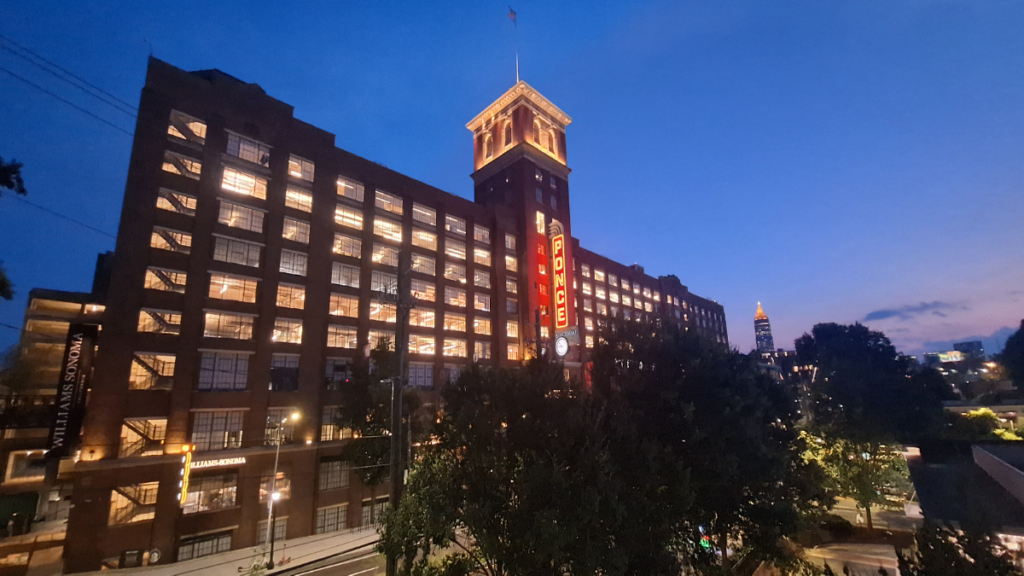
Marking the centennial of the historic 1926 Sears building, this week we explore its grand history, past eras, and a preview of our five-part series on its evolution into Ponce City Market.
On August 2, 1926, a monumental chapter in Atlanta’s commercial history began. A staggering crowd of 30,000 eager shoppers flooded through the doors for the grand opening of the massive Sears, Roebuck & Co. regional distribution center and retail store on Ponce de Leon Avenue. Covering 4 acres, the 2-million-square-foot facility was the largest brick building in the South and served as one of nine regional distribution centers built by Sears between 1910 and 1929.
To support the massive operation, the city extended North Avenue, a railroad spur was added for shipping, and the North Avenue Street Car ran between the property and Peachtree Street. Outside of its retail and mail-order operations, the building functioned almost like a small city:
- The Farmers’ Market: From 1930 to 1947, Sears hosted a farmers’ market at the back of the property, which at its peak drew an audience of 3,000 and featured local Georgia producers utilizing space provided by the company.
- The Animal Department: In the 1940s, Sears sold and shipped live animals directly from the building, including baby chicks, monkeys, and baby alligators.
- Sears Kit Houses: During the 1930s, mail-order kit houses were available through the catalogue, including a model named “The Atlanta” priced at $4,447, requiring customers to assemble the modern homes themselves.
- Automotive & Human Resources: By mid-century, departments expanded to include automotive services (later becoming Allstate) and robust human resources infrastructure, supporting a peak workforce of up to 1,000 employees while operating a cafeteria that served 1,800 meals a day.
For decades, the building hummed with the energy of hundreds of workers, heavy freight transport, and generations of Atlantans checking items off their shopping lists. Though Sears closed its Atlanta retail store in 1979 and the regional office operations concluded in 1987, the building was later purchased by the City of Atlanta in 1990 and renamed City Hall East, paving the way for its next great chapter.
Echoes from the Era of City Hall East: Voices of the Old Building
Before the sleek food halls, luxury flats, and open-air tech offices took over, the sprawling bowels of City Hall East housed a different kind of working-class and athletic energy. Between 1993 and 2006, the property was home to Lee Haney’s World Class Fitness Center, a massive 20,000-square-foot training ground run by the legendary 8-time Mr. Olympia champion Lee Haney.
Walking back through the corridors years later—where his old gym floor is now a stationery shop—Haney recalled the grit and heavy-iron culture of the space:
“We had recumbent bikes, treadmills, elliptical machines, body masters, every Nautilus piece of equipment you could think of. We also had what we called the ‘Animal Kingdom’ feature, where the really hard-core training took place: squat racks, dumbbells, heavy weights, all the suffering stuff.”
Hosting local powerlifters and fitness enthusiasts, Haney’s gym represented the industrial underground spirit of the building during its municipal years. Reflecting on how the massive structure has reinvented itself into today’s Ponce City Market, Haney noted:
“I knew there was a lot of possibility in this building… I love what they’ve done.”
The Catalyst for a New Urban Movement
When the historic property was ultimately reimagined and reborn as Ponce City Market, it didn’t just preserve a beloved architectural landmark; it fundamentally reshaped how Atlanta connects.
- The Industrial Past Reborn: The heavy freight rail lines that once fed the Sears distribution center didn’t fade into oblivion. Instead, they helped inspire the creation of the Atlanta BeltLine’s Eastside Trail, transforming industrial transit corridors into vibrant green spaces for pedestrians and cyclists.
- Bridging Neighborhoods: Just as the original 1926 building served as a decentralized commercial hub outside of downtown traffic, today’s Ponce City Market acts as a magnetic anchor linking historic neighborhoods like the Old Fourth Ward, Midtown, and the Highlands.
- A Blueprint for Adaptive Reuse: The building proved that Atlanta’s future didn’t have to rely on a “buldoze-and-rebuild” mindset. By honoring the exposed brick, steel columns, and vintage character, developers set a new standard for sustainable urban revitalization.
Looking Ahead: The Evolution Series Preview
To fully understand how this 100-year-old titan transformed into Atlanta’s ultimate live-work-play destination, this special multi-part series will explore the distinct pillars that make up the modern property’s ecosystem:
- Part 1: The Original Building (Today’s Feature): A deep dive into the 1926 grand opening, its decades as a mail-order powerhouse, the memories of its past tenants, and its role as the catalyst for the Atlanta BeltLine.
- Part 2: Residences — Flats at Ponce, Scout Living, and Signal House: An exploration of the residential spaces breathing human life back into the property, blending historic industrial lofts with flexible micro-apartments and modern wellness-focused high-rises.
- Part 3: Retail: A look at how the open-air industrial corridors and soaring halls were curated into a vibrant commercial marketplace featuring national flagships and local independent makers.
- Part 4: Food Hall: A tour through the Central Food Hall, serving as the social and culinary heartbeat where award-winning chefs, fast-casual favorites, and diverse local flavors converge under historic steel beams.
- Part 5: Corporate Business: An examination of the modern loft-style offices and tech hubs that bring a thriving 21st-century workforce back into the building’s historic economic engine.
Stay tuned as we roll out each part of this exclusive series, tracking how a century-old mail-order plant continues to shape the future of Atlanta.