


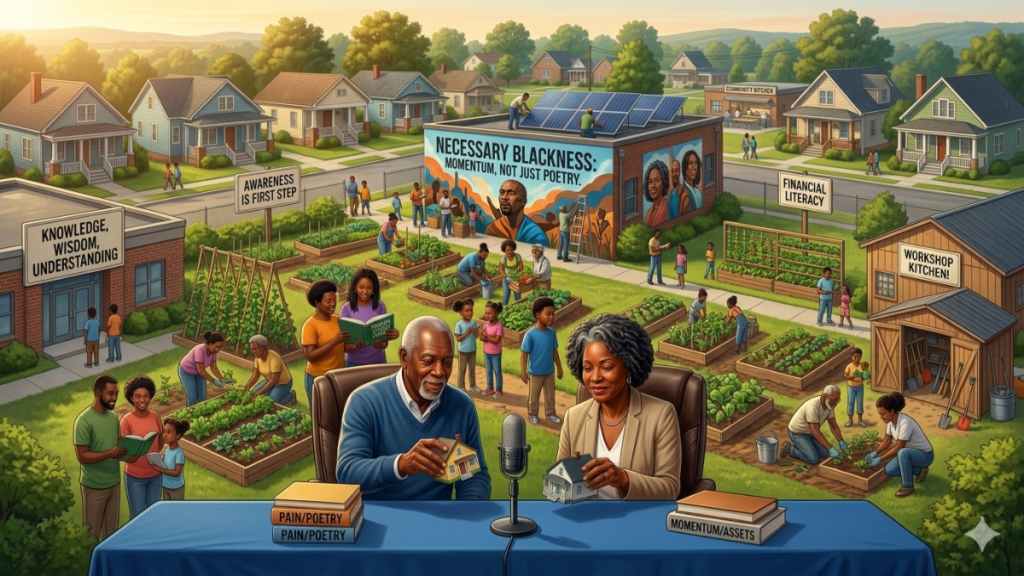
Host Rahiem Shabazz and guest Melanie Bey confront the barriers to Black economic wealth, warning against the glamorization of struggle.
ATLANTA — In a thought-provoking new episode of the Necessary Blackness Podcast, host Rahiem Shabazz and guest Melanie Bey dived into the deep-seated economic challenges facing the Black community. The conversation moved past surface-level critiques to confront a uncomfortable question: What is the core barrier preventing the Black community from securing true economic wealth and land ownership?
According to the hosts, the answer lies in a cultural habit of prioritizing creative expression over structured, long-term economic momentum.
Clarifying the Barriers to Economic Wealth
Shabazz opened the segment by probing the structural and social barriers that continue to impede the Black community from achieving true land ownership and financial prosperity. Rather than pointing solely to external socio-economic systems, the discussion turned inward, analyzing how community focus is often misdirected.
The primary barrier identified wasn’t a lack of resourcefulness or talent, but rather a collective tendency to commercialize survival instead of building equity. The dialogue challenged listeners to consider whether the community has inadvertently learned to navigate systemic poverty by romanticizing it, rather than dismantling it through financial organization.
Glorifying Poverty: ‘Sweetness to a Mess’
Bey’s perspective was both unyielding and precise, tackling the psychological and cultural habits that stall financial progression. She openly questioned whether the culture has begun to glorify poverty too much by viewing systemic hardships through a sentimental lens.
“For a great portion of us, we glorify poverty too much by continuously looking through rose-colored glasses,” Bey asserted. “We turn our pain into poetry and we don’t really look at what’s really needed for momentum.”

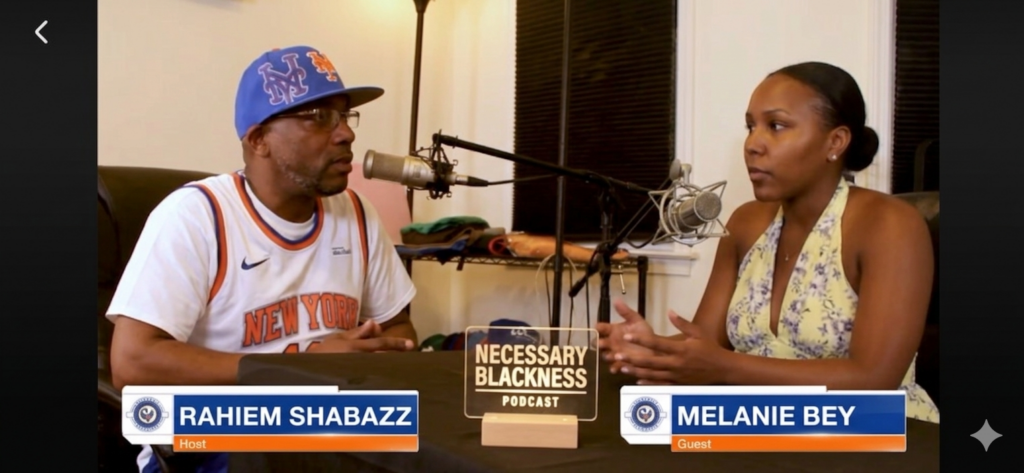
Bey explained that while cultural innovation thrives inside underserved areas, the wealth generated from that creativity rarely cycles back to the neighborhoods that birthed it. She noted that communities frequently “add sweetness to a mess,” focusing heavily on the aesthetics of a hustle rather than establishing structured socioeconomic systems.
Redirecting the Movement: Fun vs. Momentum
The core of the discussion highlighted a crucial divide between making a culture “fun” and making it a formal, sustainable movement. The host and guest agreed that Black culture is globally celebrated for its style, art, and resilience, but warned that this creative energy is being misdirected.
“Our movement is being made fun and creative, but not being directed in the right way,” Bey emphasized.
True momentum, the episode argued, requires moving away from the “poetry” of struggle. While artistic expression is a powerful tool for survival, it cannot replace the baseline requirement for tangible assets, real estate, and institutional wealth.
Shabazz strongly agreed, evoking common cultural proverbs regarding accountability and awareness. He reminded the audience that waiting for external assistance to resolve internal financial disparities is a losing strategy.
“We have to put things into action,” Shabazz stated firmly. “We are the holders of ourselves and responsibility… we have to be self-saviors. Ain’t nobody coming to save Black people.”
The episode stands as a direct challenge to Atlanta creators, entrepreneurs, and community leaders alike to pivot their efforts from simply celebrating personal survival to collectively prioritizing long-term economic stability.