


Part 2: The Granite Blueprint in the Red Clay
A Four-Part Cross-Bureau Narrative | N.E.W.S. North Preview
By the early 1920s, the “Tonic King” was ready to expand his empire. Atlanta was a city in a fever of growth, and E.W. Grove saw the “Fortified Hills” of the Northwest corridor as the perfect canvas to replicate his North Carolina masterpiece. He wasn’t just selling a neighborhood; he was exporting a lifestyle of “Mountain Luxury” to the red clay of Georgia.
The Gilded Migration
The marketing was relentless. Early advertisements for Atlanta’s Grove Park explicitly linked the project to the world-famous prestige of the Grove Park Inn. Grove sought out the highest elevations in the city to mimic the clean, respiratory-friendly air of the Blue Ridge. For Atlanta’s rising professional class, Grove Park was promised as a “health resort suburb”—a sanctuary away from the smoke and grit of the industrial core.
Stone vs. Stick: Translating the Architecture
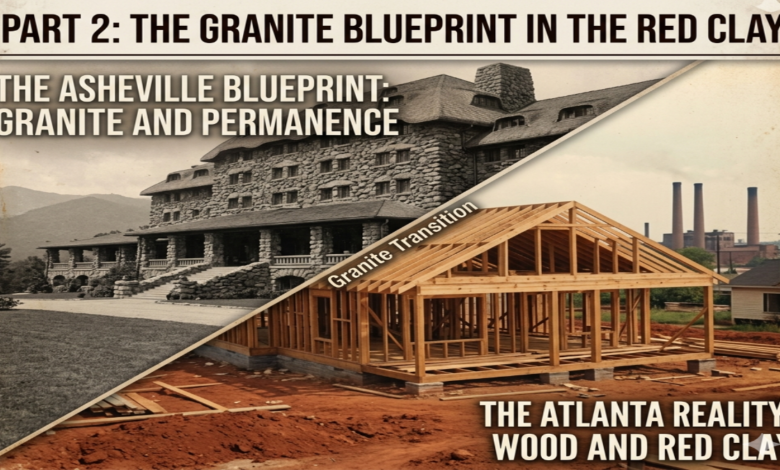
To mirror the Asheville prototype, Grove initially insisted on a specific architectural language. The “Granite Blueprint” was evident in the early foundations:
- The Stone: Massive, hand-set stone foundations and chimneys that echoed the mule-hauled boulders of the Asheville Inn.
- The Porch: Expansive front porches designed for the “outdoor living” philosophy of the Arts and Crafts movement.
- The Topography: Winding, scenic roads that followed the natural curves of the hills, shunning the rigid, hot grid of downtown.
However, as the decade progressed and demand surged, the “Granite Standard” began to face the reality of rapid expansion. The labor-intensive stone work slowly gave way to quicker, “stick-built” wood-frame construction. The blueprint was starting to drift.
The Invisible Architecture: The “Harm Report”
While Grove was engineering a resort, the city was engineering a barrier. The 2026 Fulton County Reparations Task Force “Harm Report” reveals that the development of Grove Park was governed by an “invisible architecture” of exclusion.
According to the report’s 615-page deep dive, the Grove Park Development Company was a central player in systemic displacement. Land was purchased specifically to prevent Black “encroachment”, ensuring that the “Mountain Luxury” remained an exclusive enclave.
The 100-Foot Paradox
The most striking evidence of this divergence from the Asheville vision is found near West Lake Avenue. In North Carolina, Grove used parks for recreation and wellness. In Atlanta, the “Harm Report” details how White residents successfully petitioned to have a 100-foot strip of land maintained as a park for a much darker purpose: as a physical racial barrier to enforce segregation.
This was the birth of the Paradox. While Black property owners in Fulton County were being systematically overtaxed—often paying double the tax burden of White owners to subsidize municipal infrastructure—the “Fortified Hills” were becoming a literal fortress.
A Fading Vision
As the 1920s came to a close, the Great Depression loomed, and E.W. Grove’s health finally failed him. With the “Tonic King” gone, the direct oversight of the “Asheville Standard” vanished. The blueprint was left in the hands of a city that was rapidly changing, and the “Harm” built into the soil was about to sprout.
The Blueprint Fades
As the 1920s came to a close, the Great Depression loomed, and E.W. Grove’s health finally failed him. With the “Tonic King” gone, the direct oversight of the “Asheville Standard” vanished. The blueprint was left in the hands of a city that was rapidly changing, and the “Harm” built into the soil was about to sprout.
Next Tuesday, the narrative shifts. In Part 3: Bankhead Blues, we explore the mid-century transition. We’ll look at the “Paradox of Progress”—how a community designed for exclusivity became the heart of Atlanta’s most notorious and resilient corridor.
Series Navigation
Missed the beginning? Read Part 1: The Tonic King and the Birth of a Shared Southern Heritage
Expanding the Grid: New Bureau Coverage Coming Soon
The narrative above is a glimpse into the blueprint of our expansion. As we prepare to plant flags in North Carolina we are bringing our signature focus on the lived experiences of everyday residents to these new regions.
As an independent news/media platform, our mission is to provide a dedicated voice for the local narratives that truly shares the stories of community—stories that often get lost in the shuffle of the 24-hour news cycle. From Atlanta’s Beltline to the Bay Area’s Coastline and every stop in between, the voice of the communities that we represent are growing stronger.
Welcome to the next chapter of independent journalism.






One Comment